

Executive summary:
Off-grid operations reliant on diesel and single-source renewables face increasing exposure to fuel price shocks, logistics risks, and extreme weather. LuvSide's WindSun hybrid wind-solar microgrids transform this volatility into dependable, resilient power by integrating complementary energy sources, storage, and intelligent controls. This article evaluates where WindSun systems deliver significant economic and reliability advantages-and how decision-makers can determine when a hybrid solution becomes essential for risk management.
1. Why off-grid power is under pressure
Remote operations-mines, farms, resorts, and rural facilities-have long stabilized power with diesel generators. This model is now under pressure from rising costs, complex logistics, and ongoing sustainability demands.
1.1 Diesel dependence is still the default
Despite rapid renewable energy growth, a large portion of off-grid power remains diesel-based:
- Analysts estimate around 54% of off-grid communities globally rely solely on diesel power.[1]
- In low- and middle-income countries, backup generators consume approximately 55 billion liters of diesel and gasoline annually, rivaling grid electricity costs in some markets.[2]
This creates:
- High, unpredictable OPEX linked to global fuel markets
- Vulnerability to supply chain disruptions (blocked roads, port issues, political risk)
- Increased scrutiny regarding CO₂ emissions and air pollution from regulators, investors, and customers
1.2 Single-source renewables don't solve volatility alone
Many sites have adopted standalone solar PV to cut fuel use. While this reduces daytime diesel runtime, it rarely delivers true energy resilience:
- Solar output drops at night and during long cloudy spells
- Weak grids or fully off-grid setups require oversized storage for full autonomy during extended low-sun periods
- Operators often revert to diesel backup after battery underperformance or aging, as observed in African mini-grid projects where solar-only systems returned to diesel support after storage failures[3]
1.3 The economics are shifting toward hybrids
Cost trends increasingly favor hybrid systems:
- In Pacific islands, rural diesel generation costs USD 1.00-2.50 per kWh, while off-grid solar averages USD 0.40-0.60 per kWh.[4]
- Globally, renewable installations since 2000 saved an estimated USD 521 billion in 2022 fuel costs.[6]
Every liter of diesel avoided means reducing both cost and operational risk. The strategic focus is shifting from if to hybridize to how-and with which technology mix.
2. How WindSun-type hybrid systems work
2.1 Architectural overview
A modern off-grid hybrid microgrid generally includes:
- Wind turbines (e.g., LuvSide's vertical and horizontal models)
- Solar PV arrays sized for local conditions
- Battery storage to buffer fluctuations and supply nighttime demand
- Optional diesel genset as backup or for peak loads
- Hybrid controller / EMS to manage charging, discharging, and dispatch
LuvSide's WindSun concept combines these components in a pre-engineered solution, integrating small wind turbines with PV and storage for autonomous off-grid supply.
2.2 Why wind and solar complement each other
Simply put: wind and solar balance each other's weaknesses.
- Solar peaks at midday and in summer
- Many locations experience stronger, steadier winds at night, in winter, or during storms
- Wind production continues even during extended cloudy periods
Wind "fills the gaps" of solar, reducing the need for large and expensive battery storage. This results in:
- Lower storage requirements for the same autonomy
- Fewer deep discharge cycles, leading to longer battery life
- More stable renewable generation overall
2.3 The WindSun hardware building blocks
LuvSide's WindSun hybrid system links robust small wind turbines with PV:
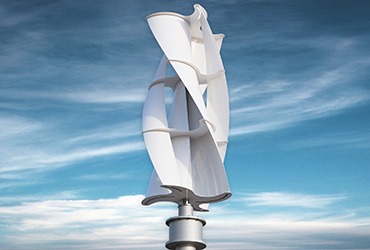
- Vertical-axis turbines like LS Double Helix 1.0 and LS Helix 3.0 excel in turbulent, urban, or coastal winds, and are suitable for public areas
- Horizontal-axis turbines such as LS HuraKan 8.0 deliver higher power for wind-intensive sites, supporting industrial loads
- In typical configurations, WindSun systems achieve nominal outputs around 28 kW at 11 m/s wind speed, covering a broad range of off-grid commercial needs
These turbines feature flow-optimized rotor and lamella designs, delivering over 25% greater efficiency than conventional Savonius-type small wind turbines, while maintaining low noise and high stability.
3. Economics of resilience: diesel vs solar vs WindSun
Understanding when WindSun-style systems make sense requires comparing risk and cost for three typical setups.
3.1 Risk and cost profile comparison
| Attribute | Diesel-only power | PV + diesel hybrid | WindSun (wind + PV + storage, diesel backup) |
|---|---|---|---|
| Fuel exposure | 90-100% diesel | 40-70% diesel, rest solar | 10-40% diesel, mainly wind+solar |
| Fuel cost volatility | Very high; OPEX follows oil prices | Medium; less daytime fuel use | Low to medium; diesel becomes an occasional backup |
| Remote island generation cost | USD 1.00-2.50/kWh | 0.60-1.50/kWh (solar share, storage) | 0.40-1.20/kWh (higher renewable share, optimized dispatch) |
| CAPEX | Low (genset only) | Medium (PV + controls + storage) | Higher (wind + PV + storage + EMS) |
| OPEX (15-20 years) | Very high (fuel + maintenance) | Medium; fuel savings but storage O&M | Low; minimal fuel and maintenance |
| Outage risk | High if fuel deliveries fail | Medium; still needs regular fuel | Low; wind+solar+storage can prevent long outages |
| Noise & emissions | High | Medium | Low (diesel runs rarely) |
| Best use case | Short-term, seldom-used backup | Modest loads, good solar | Critical, high-load, or long-term off-grid assets |
Supporting data:
- In remote Canadian communities, diesel-only systems face high costs and outages, while hybrid solutions provide more affordable, dependable power.[9]
- Tanzanian hybrid microgrids observed a 10-20% increase in solar use and at least 10% diesel reduction per year from optimized controls.[10]
- Off-grid wind+solar+diesel+storage hybrids report 60-80% diesel savings over diesel-only systems.[11]
WindSun-type systems require strategic upfront planning but break the long-term link between your energy costs and volatile fuel markets.
3.2 LuvSide's efficiency as a force multiplier
A more efficient turbine delivers greater annual energy per kW, further reducing diesel use.
LuvSide's wind turbines leverage optimized rotors and lamellas to increase aerodynamic efficiency by more than 25% compared to conventional small wind turbines, and remain robust for diverse environments.
In a hybrid microgrid, this means:
- Fewer turbines achieve target energy yield
- Additional wind capacity has a lower marginal cost with supporting infrastructure in place
- Wind increases seasonal balance, reducing storage needs compared with PV-only hybrids
4. Scenario analysis: where WindSun delivers outsized value
Wind-solar hybrids aren't for every site. But for certain operations, WindSun hybrids significantly boost resilience and economics. Three representative scenarios:
4.1 Mining and large construction sites
Remote mining sites combine high, continuous demand with tough logistics and strict HSE requirements. Academic studies confirm that integrating PV-diesel hybrids at mining sites cuts fuel and CO₂ emissions while sustaining reliability.[12]
Without WindSun:
- Multiple large diesel gensets run thousands of hours annually
- Fuel delivery is a critical risk
- ESG reports show high Scope 1 emissions
With WindSun:
- Base load supplied mainly by wind+solar; diesel is backup
- Fuel volumes and deliveries are sharply reduced
- Modular systems can relocate between temporary work sites
WindSun triggers for mining/construction:
- Gen-sets run over 3,000-4,000 hours/year
- Fuel/logistics make up >30% of OPEX
- No practical grid access
- PV alone cannot handle night or seasonal needs
LuvSide's rugged wind turbines and hybrid EMS enable uptime targets with far less diesel dependency.
4.2 Rural installations and agri-PV projects
Large farms and rural projects with good solar often face harsh winters or high seasonal load swings.
LuvSide's agri-PV experience highlights priorities for this market: reliable winter supply, smaller storage, and stable economics via self-consumption.
Why WindSun works in agriculture:
- Wind output is often higher at night and in winter-when PV is weakest
- Wind can offset part of the storage requirement, lowering CAPEX
- Turbines fit along field edges or existing structures, minimizing land conflict
For rural microgrids, WindSun ensures continuity even if supplies are delayed or fuel prices spike-critical for community resilience.
4.3 Remote hospitality and coastal facilities
Resorts, marinas, and coastal sites require quiet, reliable power to match sustainable brand promises.
LuvSide's vertical-axis turbines operate with low noise and vibration, integrating with architecture and landscapes. For example, their LS Double Helix 1.0 at Cape Town's V&A Waterfront demonstrates safe, discreet operation even in visitor-dense, windy environments.
WindSun offers remote hospitality:
- Quiet, visible renewable power to enhance sustainability image
- Fewer diesel deliveries (less noise and fumes)
- Resilient power that protects guest experience during outages
5. Practical indicators: when does WindSun make business sense?
Decision-makers often ask: When is a wind-solar hybrid preferable to PV or more diesel? While thresholds depend on site modeling, the following are strong indicators WindSun merits evaluation.
5.1 Economic indicators
A WindSun hybrid is likely beneficial if:
- Fuel spend is significant:
- Diesel, including transport/handling, is a major ongoing cost
- Fuel price swings disrupt planning or margins
- Long asset life:
- The facility will run for 10+ years, distributing CAPEX over time
- High annual runtime:
- Generators run many hours per day, not just as backup
In these cases, higher upfront investment is offset by fuel and maintenance savings and avoided outage costs over system life.
5.2 Technical and resource indicators
WindSun is optimal where:
- Resources complement:
- Steady, strong winds at night or in winter plus good solar during day/season
- Space and siting allow:
- Sufficient area or structures for turbines at suitable heights, with minimal turbulence
- Continuous load profile:
- Sites with near-constant demand benefit most from diversified renewables
LuvSide's vertical and horizontal turbines, and modular WindSun systems, are engineered to adapt to diverse sites-from coasts to offshore platforms and inland farms.
5.3 Risk and ESG indicators
WindSun also serves as risk mitigation and ESG tool where:
- Outages have high costs (lost production, asset damage)
- Regulators or investors require verified CO₂ cuts and renewable shares
- Logistics are challenging-long supply lines, access or security risks
In these circumstances, expanding beyond PV enhances efficiency and secures supply in an unpredictable world.
6. How LuvSide's WindSun approach reduces complexity
Organizations may hesitate to move beyond single-technology solutions due to perceived complexity. LuvSide's model minimizes this risk.
Key features:
- System design: WindSun systems are engineered as integrated solutions-not ad-hoc component collections
- Proven turbines: LuvSide turbines are CE-compliant, designed for harsh weather, and available in both vertical and horizontal variants to match local wind profiles
- Full-service support: LuvSide manages the full project lifecycle, from resource assessment through installation and maintenance
- Global experience: Deployments in Germany, Saudi Arabia, South Africa, and the Netherlands validate performance across climates and regulations
This provides operators with a single technical partner for core systems, reducing interfaces and focusing on secure, autonomous power.
Actionable conclusions and next steps
Hybrid wind-solar microgrids like WindSun are not just sustainability additions-they're strategic assets for stabilizing off-grid power against fuel risk, logistics hurdles, and climate extremes.
Three actionable next steps for decision-makers:
Quantify diesel risk. Analyze generator runtime, total fuel spend (including logistics), and costs from outages. If diesel is a persistent cost driver, evaluate hybrid options.
Commission resource and load studies. Assess wind and solar potential along with detailed load profiles over 12-24 months. This clarifies renewable coverage and storage sizing needs.
Run scenario-based business cases. Model diesel-only, PV+diesel, and WindSun-style systems over 15-20 years, factoring fuel price variability, carbon pricing, and outage risks.
For mines, rural assets, or remote facilities in windy regions, analysis points to the same conclusion: a well-designed wind-solar hybrid microgrid is a rational hedge and a path to sustainable energy autonomy.
Frequently Asked Questions
1. How is a WindSun-type hybrid different from simply adding wind turbines to an existing PV system?
A true hybrid like WindSun is a single, integrated system. Turbines, PV, storage, and controls are engineered and matched to each site's load and resources. In contrast, retrofits usually "bolt on" wind to existing setups without coordinated control-leading to suboptimal performance and higher maintenance.
2. Do I still need diesel generators if I install a WindSun system?
In most cases, retaining a diesel genset for rare backup or peak events is prudent. The value of WindSun comes from drastically lowering diesel runtime and fuel dependence. In well-designed hybrids, diesel shifts from primary source to rare safety net.
3. What wind conditions are required for LuvSide turbines to be effective?
LuvSide offers both vertical and horizontal turbines. Vertical-axis models handle turbulent, multi-directional winds and suit built-up or coastal areas; horizontal models like LS HuraKan 8.0 are designed for consistent, strong winds. Annual energy yield depends on detailed local wind analysis, not just a simple cut-in speed.
4. How does a hybrid system affect battery sizing and lifetime?
Adding wind delivers more nighttime and winter energy, typically reducing battery capacity requirements and increasing lifespan through shallower, less frequent charge cycles. This improves system economics versus PV-only designs that require stretching storage through prolonged dark periods.
5. What project timeline should off-grid operators expect for a WindSun deployment?
Timelines vary by project, but a typical sequence covers several months for feasibility, design, and approvals, followed by weeks to a few months for procurement, installation, and commissioning. LuvSide's modular turbine design and global experience help compress on-site work-valuable for remote or challenging locations.