

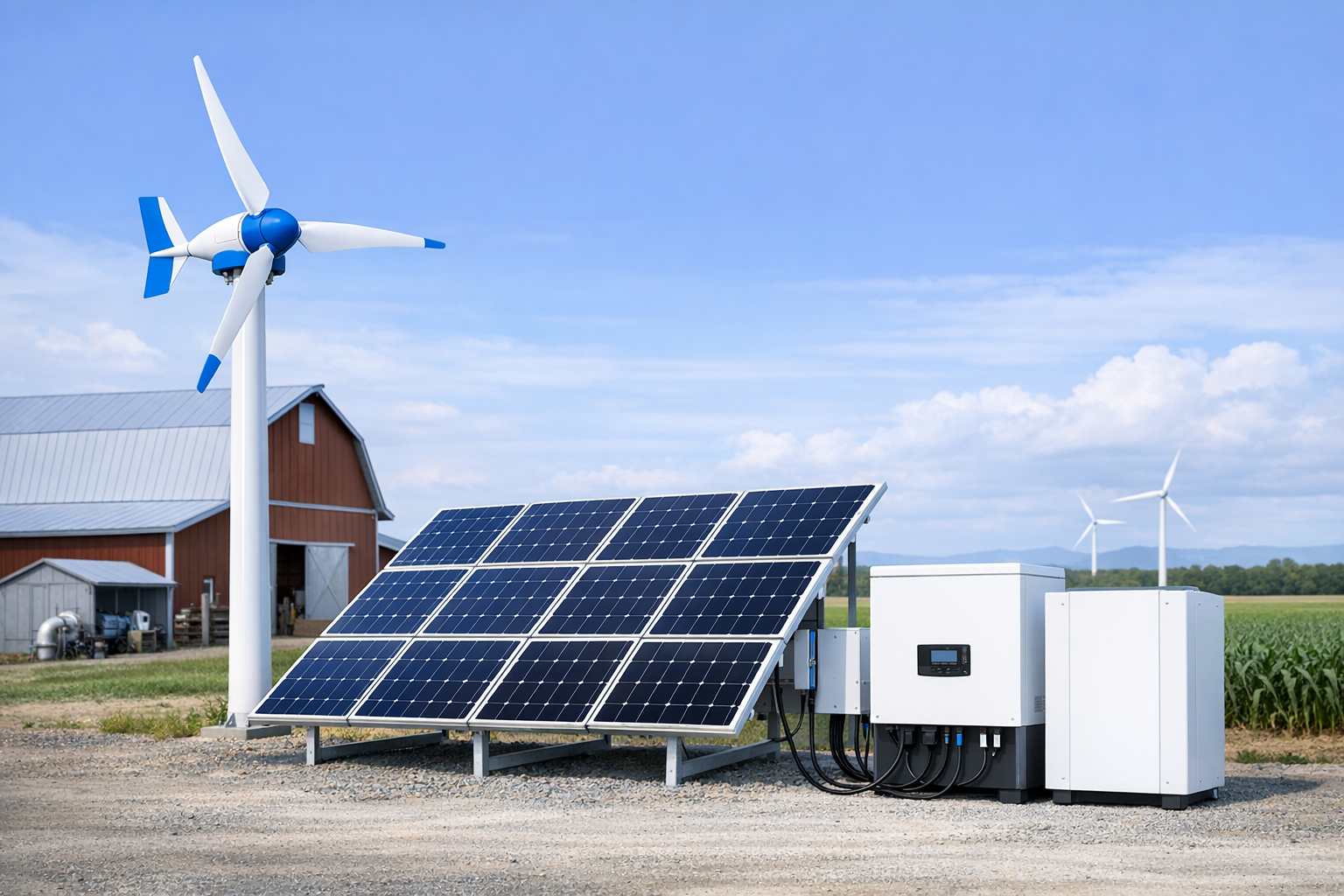
Executive summary: Farms, greenhouses, and livestock operations face rising energy costs, reliance on diesel, and the need for dependable power for irrigation and cooling. Hybrid wind-solar solutions like LuvSide's WindSun provide agricultural businesses with a clear path to decentralized energy, offering reliable performance year-round and a model-based ROI.
This article explains how WindSun hybrids operate on farms, how to size them, ideal applications (irrigation, barns, storage), and how to evaluate their business case step by step.
Why rural farms are moving beyond diesel and grid-only power
Agriculture remains heavily dependent on fossil fuels, especially diesel and oil products.
In the EU, around 58% of direct energy consumed in the agriculture and forestry sector in 2022 came from oil and petroleum products, with renewables and biofuels below 20%[1].
Globally, irrigation is among the highest energy uses on farms:
- Diesel fuel accounts for roughly 74% of the energy used for water pumping for irrigation worldwide[2]
- The agrifood sector is responsible for about 30% of global anthropogenic greenhouse gas emissions, or 16.2 Gt CO₂-eq in 2022[3]
Meanwhile, grid reliability in rural regions is often weak, and essential operations-irrigation, cold storage, and animal welfare-require uninterrupted power.
These trends drive three main challenges for farms:
- Cost: Rising electricity and diesel prices reduce profit margins.
- Reliability: Power outages threaten crops, animal health, and equipment.
- Regulation & image: Increasing ESG requirements and consumer expectations demand visible, on-site renewables.
Hybrid wind-solar systems are a practical solution-especially where both wind and solar resources are available.
Why wind-solar hybrids outperform single-source systems on farms
LuvSide's experience in small wind solutions for off-grid and hybrid applications confirms wind and solar complement each other. This synergy is especially valuable in agriculture.
Daily and seasonal balance
Typical farms in temperate climates:
- Solar outputs peak at midday, drop rapidly in the evening.
- Wind speeds often increase in late afternoon, evening, and during storms.
- Winters are typically windier, when solar yield is lowest and heating demands rise.
LuvSide's data and field projects highlight:
- Irrigation can account for 40-60% of a farm's electricity use during the growing season[4].
- Hybrid wind-solar systems reduce battery storage needs for 24/7 operation, as wind supplies power at night and in winter, minimizing large storage banks[5].
For farms, this means:
- Lower storage CAPEX: Smaller battery requirements and faster payback.
- Higher utilization: Turbines operate whenever wind is available-even on cold, cloudy days.
- More reliable coverage: Ventilation, water pumping, and controls can run continuously without oversized PV.
Inside a WindSun hybrid system for agriculture
LuvSide's WindSun system integrates small wind turbines with PV modules and, as needed, battery storage and a backup generator. The design supports modular, decentralized energy in windy regions.
Core components
A typical WindSun setup includes:
- Small wind turbines (e.g., LS HuraKan 8.0 or LS Helix models)
- PV field (roof-mounted or agri-PV between crop rows)
- Hybrid inverter and controller managing wind, solar, storage, and grid/generator
- Battery bank for defined hours of autonomy
- Optional diesel generator for rare extremes or policy requirements
LuvSide turbine characteristics
Technical highlights:
- The LS HuraKan 8.0 rated at 8 kW (11 m/s wind), with an annual yield around 12,000 kWh[6].
- WindSun hybrids combining LS HuraKan 8.0 and PV deliver about 28 kW nominal capacity at 11 m/s, PV-dependent[6].
- LuvSide's vertical Helix turbines achieve over 25% higher efficiency than conventional Savonius-type designs[7].
These features deliver:
- Higher kWh per square meter of wind infrastructure
- Stable output at lower wind speeds (vital for inland regions)
- Robust, low-maintenance operation in diverse environments
Where WindSun hybrids create the most value on farms
Hybrids are most beneficial for critical, predictable loads, making on-site generation a sound investment.
High-value use cases
Irrigation and water pumping
- Deep-well pumps, pivot and booster systems
- Most effective where irrigation is prolonged and energy prices are high
Livestock facilities
- Barn ventilation and climate control
- Automated feeding, milking, and water supply
Greenhouses and horticulture
- Ventilation, shading, circulation pumps
- Supplemental lighting and climate-control
On-farm processing and storage
- Grain drying, aeration
- Cold storage for produce, dairy, or meat
- Packing and light processing
In these areas, downtime has immediate financial effects. Hybrid systems improve resilience without excessive PV and storage.
How to size a WindSun hybrid for your farm
Start sizing from actual energy use by season, not turbine or panel specs. Use this practical approach based on LuvSide guidance[4].
Step 1 - Map your energy demand by season
- Collect 12-24 months of electricity bills and diesel use.
- Separate into:
- Base loads: Always on (controls, basic lighting)
- Seasonal loads: Irrigation, drying, heating
- Peak loads: Motors, compressors
- Calculate each in kWh/day and kW peak per month.
Focus on the 50-70% of total use that is both predictable and high-value.
Step 2 - Assess solar and wind resource
- Use national or regional solar and wind atlases.
- Get site-specific data where possible (mast data, local turbines, or assessments).
- Check:
- Average wind speed at hub height (e.g., 12 m for HuraKan 8.0)
- Wind direction, turbulence (trees, buildings, terrain)
- PV potential and usable area
As a rule: consistent wind speeds above ~5-6 m/s at hub height and open exposure make small wind a solid addition to PV.
Step 3 - Decide your autonomy and reliability targets
Determine what the hybrid system must deliver:
- Self-consumption optimization: Maximize on-site use while grid-connected.
- Backup and resilience: Guarantee essential loads during outages.
- Off-grid autonomy: Operate core functions almost entirely off-grid.
Each approach affects storage sizing, inverter selection, and need for backup.
Step 4 - Define a preliminary hybrid mix
Combine load and resource data for an initial estimate. Use these illustrative ratios:
| Farm type | Critical loads | Solar share of annual kWh | Wind share of annual kWh | Storage (hours of critical load) |
|---|---|---|---|---|
| Dairy / livestock | Ventilation, cooling, milking | 40-60% | 30-50% | 6-12 |
| Irrigated arable | Pumps, pivot irrigation | 30-50% | 40-60% | 4-8 |
| Greenhouse & horticulture | Climate control, pumping | 50-70% | 20-40% | 6-12 |
LuvSide or an engineering partner can refine this with simulation tools.
Step 5 - Iterate with real turbine and PV options
Translating the mix into practical components, an engineer could specify, for example:
- 1-2 × LS HuraKan 8.0 turbines (≈24,000 kWh/year combined on site)
- 40-60 kWp PV
- Batteries for 6-8 hours of critical load
- Hybrid controller prioritizing irrigation and storage
This phase will include interconnection studies and layout planning.
ROI: What farmers can realistically expect from WindSun systems
LuvSide's agricultural guidance and small-wind market studies provide the following:
- Complete small-wind systems for farms generally range from US$3,000-8,000 per kW installed, including all components[4].
- Typical payback periods for farm-scale small wind are 8-15 years, depending on wind resource, electricity prices, and incentives[4].
Wind-solar hybrids enhance economics versus wind- or diesel-only by:
- Higher capacity factor: Increased annual kWh per kW of equipment
- Smaller storage: Balanced output enables smaller batteries
- Fuel savings: Each kWh from wind or solar reduces diesel and grid use
An illustrative ROI scenario
A mid-sized irrigated farm:
- Annual electricity use: 60,000 kWh
- Average electricity price: 0.25 €/kWh
- Annual energy cost: 15,000 €
A WindSun hybrid covers 60% (36,000 kWh/year) through on-site wind and solar, serving irrigation and storage.
- Avoided grid purchases: 36,000 kWh × 0.25 €/kWh ≈ 9,000 €/year
- Hybrid CAPEX: 120,000 € (all equipment and installation)
- Simple payback: 120,000 / 9,000 ≈ 13 years
This aligns with the 8-15 year range above. Rising energy prices or incentives can shorten payback. Substituting diesel yields additional savings.
Note: Always base ROI on detailed, site-specific studies including measured wind data and local tariffs.
Integration with irrigation, water systems, and livestock facilities
A strong business case depends on direct integration with key loads.
Irrigation and water pumping
Since irrigation can dominate farm energy use, hybrids should prioritize these loads:
- Operate pumps when wind/solar are available
- Use storage for short-term needs
- Grid or genset as fallback
With diesel still providing nearly three-quarters of global irrigation pumping energy[2], shifting to wind and solar delivers major financial and environmental benefits.
Livestock and controlled-environment agriculture
Livestock and greenhouse operations are sensitive to outages:
- Climate failures risk crop and animal health
- Milking and cooling require steady operation
Hybrid controllers can prioritize these functions, maintaining crucial loads during interruptions and deferring less urgent ones.
Grid-tied vs. fully off-grid
Many European and North American farms favor grid-tied hybrids with net-metering. LuvSide's small wind technology is used in grid-tied, off-grid, and coastal installations across Germany, South Africa, Saudi Arabia, and the Netherlands.
Remote sites can achieve microgrid-grade autonomy with the right WindSun configuration.
Practical checklist for planning a WindSun pilot on your farm
Following these steps reduces project risk and accelerates decisions.
1. Clarify objectives and constraints
- Target % of on-site renewable generation
- Critical loads to protect (kW and kWh/day)
- Budget and desired payback
- Site, visual, and noise requirements
2. Gather data
- 12-24 months of energy bills and diesel records
- Details of existing PV systems, if any
- Site plan with existing and proposed locations
- Any local wind measurements or neighboring turbine data
3. Pre-feasibility assessment with a specialist
Work with a hybrid expert (e.g., LuvSide partners) to:
- Screen resources (wind and solar)
- Identify best sites for turbines and PV
- Develop preliminary sizing
- Estimate CAPEX and OPEX
4. Detailed engineering & permitting
- Complete resource and yield assessments
- Select turbine type and PV design
- Plan electrical integration and safety
- Ensure compliance with local permitting (setbacks, heights, grid connection)
5. Implementation and commissioning
- Prepare foundations, cabling, mounting
- Install and commission turbines, PV, and batteries
- Train local staff for operation and inspections
6. Monitoring and optimization
- Track generation, loads, and diesel/grid use
- Optimize schedules for better self-consumption
- Follow preventive maintenance plans
WindSun's modular architecture allows stepwise expansion as needed.
Frequently Asked Questions
How do I know if my farm is windy enough for a WindSun system?
A professional assessment is best, but as a first check:
- Average wind speeds above 5-6 m/s at hub height
- Minimal turbulence, open surroundings
LuvSide and partners can estimate yield using public wind maps, local measurement, and turbine data.
Can I start small and expand later?
Yes. Both small wind and PV are modular. Many farms begin with a single turbine and modest PV, then scale up as needs evolve. LuvSide's system architecture supports phased expansions.
What happens during calm, cloudy periods ("dunkelflaute")?
The hybrid controller manages priorities:
- Use wind and solar energy.
- Draw from batteries for critical loads.
- If needed, use grid or backup generator.
Sizing proactively addresses worst-case conditions to deliver defined reliability (e.g., 99% uptime for essentials).
How much maintenance do small wind turbines require on farms?
Modern turbines are designed for low, routine maintenance:
- Farm staff conduct visual inspections and basic checks
- Certified technicians perform annual inspections, bolt checks, lubrication, and electrical tests-frequency similar to tractor servicing[4].
There's no need for fuel deliveries or oil changes, reducing operational demands compared to diesel generators.
What incentives are available for hybrid wind-solar in agriculture?
Programs vary by region and may include:
- Grants for renewable investments
- Feed-in tariffs or premiums for exported energy
- Tax benefits for equipment
- Support through agricultural development programs
Early policy and incentive research-ideally with local energy or agriculture consultants-is recommended. This ensures optimum project funding and regulatory alignment.
Conclusion:
Decentralized WindSun hybrids provide farms, greenhouses, and livestock operations with a reliable, efficient path to energy autonomy and cost savings. By focusing on load profiles, carefully assessing on-site resources, and following a structured sizing and ROI process, decision-makers can move from sustainability goals to practical, proven solutions for farm energy supply.