
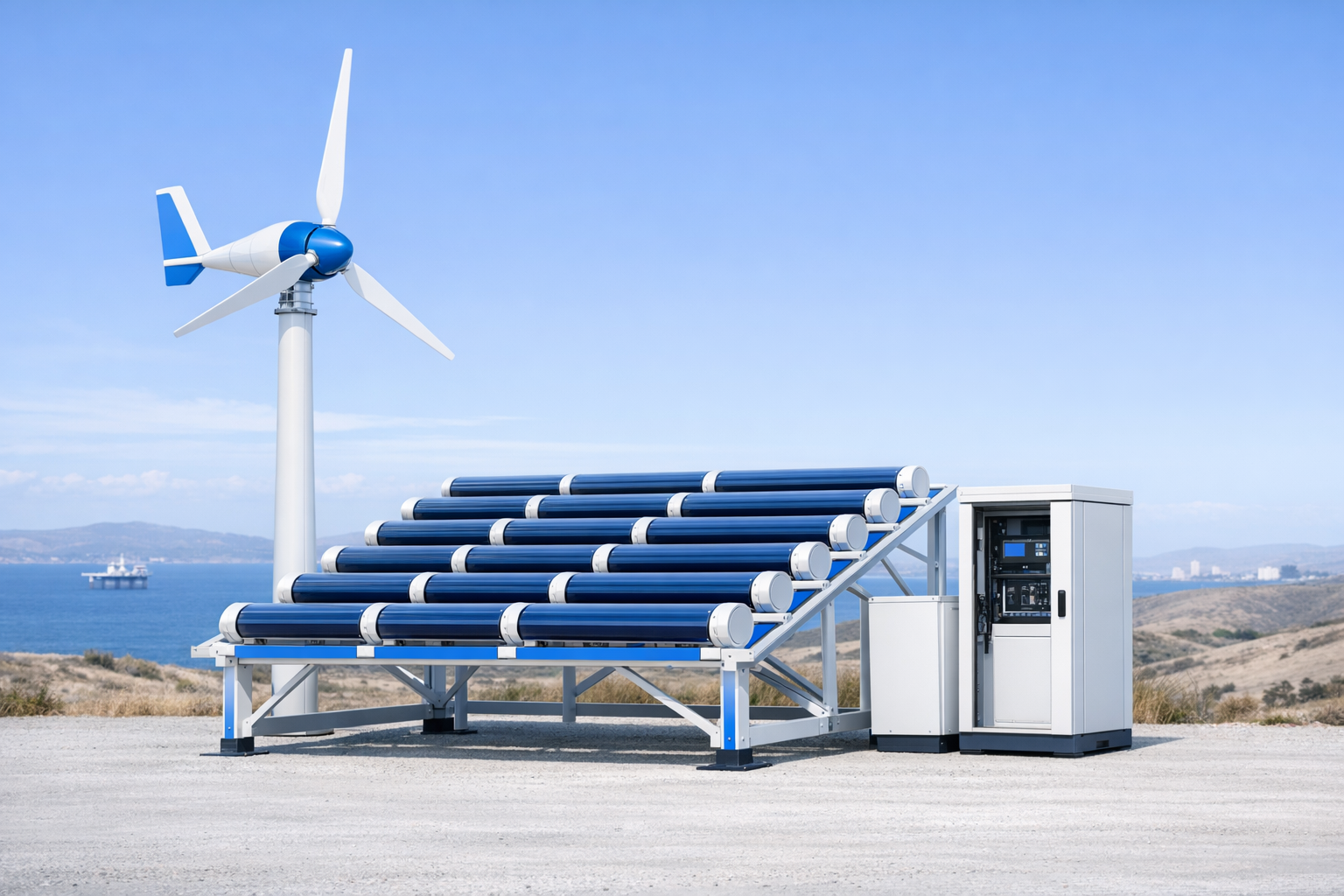
Remote operations in agriculture, mining, remote hospitality, and island infrastructure increasingly rely on uninterrupted power where grids are weak, unstable, or unavailable. LuvSide's WindSun hybrid wind-solar systems provide a resilient alternative to diesel generators and pure solar setups by combining complementary resources, intelligent control, and robust small-wind technology.
This article examines how WindSun-style hybrids improve reliability, lower lifetime costs, and mitigate fuel and grid risks-drawing on current research, industry case studies, and LuvSide's experience with off-grid and hybrid systems.
The new risk landscape for remote and off-grid power
Traditionally, remote businesses used diesel generators or, more recently, PV-only microgrids. Both now face growing risks.
Key risk drivers for off-grid operators:
- Fuel price volatility: Diesel costs fluctuate with global markets and local logistics, making OPEX unpredictable.[1]
- Logistics and access: Fuel deliveries can be delayed by weather, political instability, or supply-chain disruptions-often when power is most critical.[1]
- Weather-driven intermittency: Solar-only systems struggle during extended cloudy periods, winter, and at night, increasing battery reliance.[2]
- Regulatory and ESG pressure: There is rising demand to reduce diesel runtime and CO₂ emissions in remote infrastructure.[1]
For operators of farms, mines, remote lodges, and island utilities, the question now is: "Which energy system stays reliable and affordable as conditions change?"
Hybrid wind-solar systems, especially integrated solutions like LuvSide's WindSun, are engineered for this uncertainty.
Why hybrid wind-solar beats single-source renewables for reliability
Wind and solar have complementary generation profiles. Solar peaks at midday; wind often strengthens in the evening, at night, or during storms, when solar output drops.[1] Integrating both with storage and smart controls creates a smoother, more predictable power supply.
Evidence from hybrid microgrid research
A recent study in Sub-Saharan Africa compared PV-battery, wind-battery, and PV-wind-battery off-grid setups.[3]
- The PV-wind-battery system had the lowest annual load loss (6.6762 × 10³ kWh), outperforming others in meeting demand.[3]
- It delivered about 97% of energy from PV, 2% from wind, and less than 1% from batteries, showing lower storage dependence.[3]
This means:
- Smaller batteries can achieve target reliability.
- Batteries cycle less, lasting longer.
- The system is less exposed to periods of low sun or wind, since resources and batteries share the load.
For remote sites where battery replacement is costly and logistically challenging, these improvements enhance resilience and cut lifecycle costs.
24/7 generation and seasonal balance
LuvSide's market analyses show three key advantages of hybrid systems over solar-only:
- Continuous generation: Wind turbines produce power at night and during storms with low solar generation.
- Reduced storage requirements: Night and storm generation from wind lowers necessary battery capacity.
- Seasonal complementarity: In many regions, wind is stronger in autumn and winter when solar output drops, supporting year-round supply.
WindSun is specifically designed to utilize these complementary resources, minimizing the need to oversize any single technology.
Inside LuvSide's WindSun hybrid architecture
LuvSide specializes in small wind turbines for decentralized energy, offering vertical-axis and horizontal-axis models built for efficiency, quiet operation, and durability. WindSun unites this wind expertise with advanced PV modules and intelligent control in a compact hybrid design.
Key performance characteristics
- WindSun hybrid modules combine a LuvSide small wind turbine with PV modules for a nominal output of around 28 kW at 11 m/s wind speed.
- The LS HuraKan 8.0 horizontal-axis turbine delivers 8 kW at 11 m/s and about 12,000 kWh annually at suitable sites, using a 6 m rotor on a 12 m mast.
- LuvSide turbines use optimized rotor and lamella geometries, yielding over 25% higher efficiency than conventional small-wind designs.
On the solar side, WindSun's tubular PV modules are elevated and wind-friendly, allowing rain and sunlight to reach the ground below.[4] This design supports agri-PV and multiple land uses.
Further benefits:
- WindSun modules can yield up to 145% more energy per kWp than flat PV systems, due to dual-use structure and optimized geometry.[4]
- Installations reach about 15 meters in height and can often be permitted through simplified processes, thanks to compact footprints and lightweight, concrete-free foundations.[4]
- Deployment typically takes three to six months from planning to commissioning.[4]
Control and dispatch for resilience
A centralized control system optimizes wind, solar, and storage operation:[5]
- Prioritizing renewables for active loads.
- Charging batteries when wind or solar surplus is available.
- Adjusting wind turbine output at night or during low-solar periods.
- Enabling remote monitoring and predictive maintenance to reduce unplanned downtime.
Hybrid installations with such controls achieve high system availability by combining generation redundancy and smart maintenance.[5] WindSun brings these benefits to compact, modular industrial and commercial systems.
Reliability and lifecycle economics: from diesel to hybrid backbones
Each site is unique, but trends emerge when comparing diesel-only, PV-only, and hybrid microgrids.
Lessons from large-scale hybrid projects
A well-known mining case study combined a 57 MW diesel station with a 15 MWp solar array. Results:[6]
- The PV-diesel hybrid saved about 6 million liters of fuel per year versus diesel-only.[6]
- LCOE fell from 0.219 USD/kWh (diesel only) to roughly 0.205 USD/kWh with hybridization, storage, and derating.[6]
Smaller remote sites see similar drivers: fuel savings, lower OPEX, and greater resilience to fuel supply issues.
LuvSide's market analysis confirms this for telecom, agriculture, and critical infrastructure: fuel and maintenance savings over the asset lifetime typically exceed higher initial CAPEX, and regulatory/ESG benefits strengthen the case.[1]
Comparative risk profile: diesel vs PV-only vs WindSun hybrid
| Criterion | Diesel generator-only | PV-battery only | WindSun hybrid (wind + solar + storage) |
|---|---|---|---|
| Fuel price exposure | High; OPEX driven by diesel | None, but batteries replaced periodically | None for generation; smaller storage lowers replacements |
| Logistics risk | High; fuel delivery essential | Low; mainly spare parts | Low; spare parts only, no fuel logistics |
| Seasonal performance | Strong if fuel available | Weak in winter/cloudy spells; large batteries needed | Wind balances winter/shoulder seasons; more stable profile |
| Night-time reliability | High if fuel on hand | Fully dependent on battery storage | Wind generation reduces battery strain at night |
| Battery sizing | Minimal/none | Large for target reliability | Smaller than PV-only, same reliability |
| Maintenance profile | Frequent fuel/service/overhaul | Low, but battery replacements can be major | Low-medium; periodic service, long component life |
| Emissions & ESG | High CO₂/local pollution | Very low local emissions | Very low local emissions |
WindSun-style hybrids shift operational risk away from unpredictable OPEX to robust, long-life renewable assets and more predictable CAPEX.
Sector-specific design considerations with WindSun hybrids
Agriculture and agri-PV
Agri-PV and large farms require reliable power for irrigation, storage, processing, and digital systems-often in windy, grid-constrained regions.
WindSun offers agriculture-specific benefits:[4]
- Elevated PV tubes (about 4.5 m) maintain full land use for crops or equipment.
- Shading benefits soil and sun-sensitive plants.
- Tubular design reduces storm and hail vulnerability.
- Hybrid generation cuts battery size and aligns with seasonal farm demand.
Remote hospitality and island operations
Off-grid lodges, eco-resorts, and islands must combine autonomy with guest comfort.
LuvSide's turbines are engineered to be quiet and visually compact, supporting requirements for non-intrusive, aesthetic infrastructure. With WindSun, this means:
- Quiet, steady power; less generator runtime for guest comfort.
- An appealing, visible sustainability feature for hospitality branding.
- Reduced diesel logistics-cutting costs and simplifying operations for islands.
Mining and large construction sites
Mining and temporary construction operate in tough, remote conditions. Diesel is flexible, but has supply, cost, and emission drawbacks.
Hybrid systems blending wind, solar, and storage are used to reduce diesel runtime.[6] LuvSide's robust turbines and modular systems are well-suited for:
- Rapid deployment on lightweight foundations, minimal civil works.
- High durability for tough environments.
- Replicable modules to scale with site size.
- Seamless integration as a fuel-saving layer with existing diesel fleets.
Critical infrastructure and telecom
Telecom, water plants, emergency services, and public safety comms need high-reliability power with stringent uptime requirements.
Hybrid wind-solar systems with storage reduce fuel reliance and boost resilience during outages.[1] LuvSide's turbines and WindSun architecture enable decentralized designs that meet uptime and compliance needs while lowering lifecycle costs.
How to specify a WindSun hybrid for a remote operation
For decision-makers, moving from concept to bankable design involves these steps:
Define critical loads and uptime needs
- Identify essential loads (e.g., cold chains, pumps, safety systems).
- Quantify daily and seasonal profiles in kWh/day and peak kW.
Assess wind and solar resources
- Use site-specific irradiance and wind data or datasets.
- Identify seasonal complementarity to optimize hybrid mix.
Select wind-solar ratio
- In sunny areas, PV dominates with wind as buffer; in windy areas, strong wind inputs minimize storage.
Size storage and backup
- Design batteries for autonomy and DOD limits, reflecting the hybrid's stable profile.
- Retain diesel backup for rare events as needed.
Address siting, permitting, and design
- Consider noise, visuals, access, and agricultural compatibility.
- Leverage WindSun's compact, light foundation for easier permits.[4]
Plan O&M and monitoring
- Schedule regular inspections for turbines, PV, and batteries.
- Use remote monitoring for early fault detection and maintenance planning.
Model techno-economics
- Compare diesel, PV-only, and WindSun hybrids, considering total cost of ownership.
- Evaluate LCOE, maintenance, asset replacement, and OPEX.[6]
Working with an experienced provider ensures systems meet operational and financial objectives.
Conclusion: Building a resilient backbone in an uncertain world
Remote operations today must manage volatility in fuel, grid reliability, weather, and regulation. LuvSide's WindSun hybrid offers a practical route to energy autonomy: high-efficiency wind turbines, advanced PV, and smart control in a modular, robust system.
By combining wind and solar, reducing battery needs, and eliminating fuel logistics, WindSun hybrids shift power supply from ongoing risk to a strategic asset. For agriculture, mining, hospitality, islands, and critical infrastructure, this helps operations move from reactive to resilient.
Frequently Asked Questions
How does a WindSun hybrid keep power running at night and during bad weather?
WindSun systems blend wind turbines, PV, and storage. At night, the wind turbine can generate if wind is present; batteries cover gaps.[1] During storms or overcast periods, wind often partially compensates for low solar output, stabilized by system controls.
What happens on calm, cloudy days?
During rare spells of low wind and sun, the system relies more on batteries and, if configured, on backup generators. Proper sizing of storage and backup-using historical weather data and uptime needs-ensures coverage of these events.[3]
How does WindSun work with existing diesel generators?
Many sites keep diesel as a backup. WindSun serves as primary power, reducing diesel to emergency or peak use. Controls trigger generators only when battery SOC and renewables fall below set thresholds, maximizing fuel savings and maintaining reliability.[1]
What kind of maintenance does WindSun need in remote areas?
Maintenance includes regular checks of turbines (mechanics, blades, tower), PV modules (cleaning, inspections), and batteries (monitoring, safety). Hybrids need fewer site visits than diesel, avoiding fuel logistics, and benefit from remote monitoring and scheduled service to sustain uptime.
Are hybrid systems suitable for small farms and lodges, or just large industrial projects?
Hybrid systems scale efficiently. LuvSide's small wind turbines and WindSun modules are made for decentralized applications, from single farms and lodges to industrial clusters. Properly sizing the system to site needs is key for performance and value.