

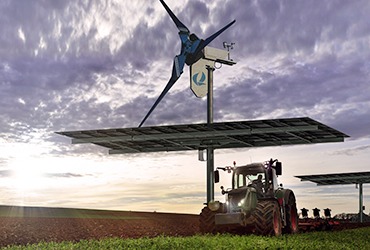
Remote mining operations run 24/7, but their power supply often does not. Fuel logistics, grid instability or a lack of grid access make conventional energy strategies risky and expensive. This article shows how hybrid systems that combine small wind turbines, solar PV and existing generators can reduce downtime, stabilise costs and strengthen long-term resilience - with a focus on LuvSide's compact, German wind turbine solutions.
Key Insights: Why Hybrid Power Is a Strategic Asset for Mines
- Downtime is a major cost driver: Even short power interruptions in critical processes (crushing, hoisting, dewatering) can cost tens of thousands of euros per hour in lost production and restart losses.
- Diesel-only concepts are increasingly fragile: Price volatility, supply-chain disruptions and tightening ESG targets make pure diesel generation a strategic and financial risk - especially in remote, off-grid operations.
- Hybrid systems hedge against uncertainty: Combining PV, off-grid wind turbines and backup generators spreads risk across multiple energy sources and improves availability across day, night and seasons.
- Small wind turbines add value where PV is weak: At night, during dust storms or in shoulder seasons, a vertical wind turbine can keep essential loads supplied when solar output is low.
- Lifecycle cost beats upfront price: When you factor in fuel, logistics, maintenance and CO₂ costs over the life of a mine, a decentralised hybrid system can significantly reduce total cost of ownership.
Insight 1: Downtime Risk Demands a Redundant, Decentralised Energy Mix
Design your power system around the cost of failure, not just the cost per kWh
Many mine power strategies still focus on the levelised cost of electricity alone. In practice, the far bigger lever is the cost of unplanned downtime: halted conveyors, idle processing lines and safety-critical systems under stress. A centralised generation setup - one main diesel plant or a single grid connection - becomes a single point of failure.
A hybrid approach distributes generation and therefore risk. A combination of solar PV, small wind turbines and existing diesel or gas generators creates a decentralised energy system: even if one source is constrained, others can maintain critical loads. LuvSide's compact vertical wind turbine solutions are particularly suited to this architecture. Multiple units can be sited close to energy demand (e.g. near processing plants, pumping stations or accommodation camps), creating a resilient microgrid rather than one vulnerable power spine.
Translate redundancy into predictable operations and lower OPEX
For mine operators, the business case is straightforward: stable energy enables stable production. By covering a significant share of base load with renewables, hybrid systems reduce fuel run hours, extend maintenance intervals on generator sets and lower exposure to fuel price spikes. When wind and PV are dimensioned properly, diesel use can shift from being the first line of supply to a strategic backup.
The implication is a more predictable operating expenditure profile over the life of the mine. With LuvSide's WindSun hybrid concept, wind and solar work together to smooth generation: solar covers peak daytime loads, while off-grid wind picks up during night-time and windier periods. This combination improves the utilisation of installed capacity and makes it easier to match long-term offtake contracts, production plans and ESG targets to a stable, low-carbon power profile.
Insight 2: Modular Small Wind Turbines Support Mine Expansion and Mobility
Use compact, vertical wind turbines as flexible building blocks
Mines are dynamic: pits migrate, processing trains expand, and temporary infrastructure becomes permanent or disappears altogether. Rigid, central power plants can struggle to keep up. By contrast, small wind turbines with a compact footprint can be added, relocated or reconfigured as the site evolves.
LuvSide's vertical wind turbine designs - such as the LS Double Helix and LS Helix models - are engineered for robustness and simplicity. Their vertical-axis design captures wind from all directions without complex yaw systems, which is ideal for turbulent air flows around mine buildings, stockpiles and pit edges. Because they are relatively easy to transport and install, they can follow the mine as it grows or shift from construction camps to long-term operations.
Match power where it is needed - and shorten weak links in your network
Decentralised power is not only about energy sources; it is also about distances. Long cable runs from a central plant to remote pumps, monitoring stations or ventilation systems increase losses, complexity and vulnerability. By placing small wind turbines closer to critical loads, operators shorten this chain.
In practice, that can mean powering remote communication masts, water treatment facilities, exploration camps or security infrastructure with a local PV-wind hybrid cluster instead of extending high-capacity feeders. This approach reduces infrastructure CAPEX, simplifies permitting and creates localised pockets of autonomy that continue working even if the main distribution network is down. For mines in Europe, Africa or remote parts of other continents, these compact, German wind turbine systems can form the backbone of resilient off-grid solutions.
Insight 3: Lifecycle Performance Depends on Design, Service and Monitoring
Optimise wind turbine design and hybrid control from the start
Selecting "any" small wind turbine is not enough; design details directly affect output and reliability. Aerodynamically optimised rotor and blade geometries increase annual energy production, especially at low to medium wind speeds, which are common on many mine sites. Low-noise operation is also valuable - not only for environmental and community acceptance, but for worker comfort in accommodation areas.
A well-integrated hybrid controller is equally crucial. It must coordinate PV arrays, wind turbines, battery storage (where used) and backup generators to maintain grid stability, prioritise renewables and protect equipment. As a specialist wind turbine supplier for decentralised energy systems, LuvSide brings wind energy consulting, system design and control expertise to ensure that turbines, inverters and control logic work together as a coherent renewable energy system.
Plan for serviceability in remote, harsh conditions
Mining environments are demanding: dust, vibrations, temperature extremes and limited access all stress equipment. A realistic power concept therefore has to consider wind turbine installation, maintenance and service just as much as nameplate capacity.
LuvSide's compact wind energy solutions are developed with simple, robust mechanics and accessible components to minimise on-site intervention times. Preventive maintenance can be aligned with existing service windows for generators or other plant equipment. Remote monitoring and condition-based maintenance strategies help to detect anomalies early and schedule interventions before failures occur. The result is higher availability, lower lifecycle cost and more reliable CO₂-reduction performance from your wind energy projects.
Conclusion and Next Steps: Making Hybrid Power Work for Your Mine
Hybrid power is no longer a niche experiment; for remote mines it is a pragmatic response to an uncertain world. By combining PV, off-grid wind turbines and backup generation in a decentralised energy architecture, operators can reduce downtime, smooth operating expenses and improve their sustainability profile.
For decision-makers in mining, three next steps are key:
- Analyse your critical loads and downtime cost - Quantify what an hour of power loss costs across core processes and use this to define the required level of redundancy.
- Evaluate your local resource mix - Assess wind and solar potential, site layout and expansion plans to identify where compact wind turbines and PV will deliver the greatest value.
- Select experienced partners - Work with a wind turbine supplier that offers end-to-end support: from feasibility and wind energy consulting through to wind turbine installation, hybrid system integration and long-term service.
LuvSide's German wind turbine technology, WindSun pv wind hybrid systems and comprehensive service offering are designed to help mining operations worldwide move toward resilient, decentralised power - and turn energy autonomy into a competitive advantage.
Frequently Asked Questions: Hybrid Wind-Solar Systems for Mining Operations
How does a PV-wind hybrid system work on a mine site?
A PV-wind hybrid system combines solar panels, small wind turbines and often battery storage with existing diesel or gas generators. The control system prioritises renewable sources, using wind and solar to cover as much of the load as possible. Excess energy can charge batteries or support non-critical loads. When renewable output is insufficient, generators step in to maintain stability. The result is a reliable microgrid that reduces fuel use and improves overall efficiency without compromising production.
What wind conditions are needed for small vertical wind turbines to be viable?
Small vertical wind turbines are particularly effective at sites with medium wind speeds and consistent wind throughout the year. Because vertical-axis designs can handle gusts and changing wind directions well, they are suited to complex terrains around mines. A detailed site assessment will typically include wind measurements or modelling, analysis of obstacles and turbulence, and an estimation of annual energy yield. From there, the number and placement of turbines are optimised to support your decentralised power goals.
How is maintenance managed in remote locations?
For remote mine operations, maintenance strategies focus on simplicity, robustness and predictability. LuvSide's small wind turbine systems use durable, low-wear components and straightforward mechanical designs to keep service needs low. Scheduled inspections are usually aligned with other site maintenance routines, and critical spare parts can be stocked on site to minimise response times. Remote monitoring via SCADA or similar systems allows operators to track performance, identify issues early and coordinate wind turbine service efficiently.
Can hybrid wind-solar systems help with ESG and CO₂-reduction targets?
Yes. By displacing a portion of diesel or coal-based grid electricity with renewable generation, hybrid systems directly reduce CO₂ emissions associated with mine operations. They also demonstrate a clear commitment to sustainability, which supports ESG reporting, stakeholder communication and permitting processes. Because the turbines and PV arrays are visible on site, they become tangible proof points of innovation, efficiency and environmental responsibility.