

In an increasingly volatile energy world, off-grid readiness is not a "green extra" but a risk management strategy. This guide shows how agriculture, tourism and mining operators can budget hybrid wind-solar projects pragmatically-using realistic ROI ranges, clear risk assumptions and phased deployment-drawing on the capabilities of compact, German small wind turbines from LuvSide.
Key Off-Grid Budget Insights at a Glance
- Diesel-only generation at remote sites often costs between roughly 0.35 and 0.70 per kWh once fuel, transport and taxes are included, making it one of the most expensive long-term power options. (pv-magazine.com)
- Adding solar PV to diesel mini-grids can cut fuel use by around 25%; adding storage can push diesel savings towards 70%, with typical payback periods of about 4-7 years for the solar and storage investment. (pv-magazine.com)
- Across commercial, industrial and agrivoltaic PV projects, typical payback times cluster between 4 and 8 years, with annual returns of roughly 8-15% depending on tariffs and solar resource. (hj-ess.com)
- Studies of off-grid solar and hybrid generator systems report payback periods in the 3-9 year range-often faster in fuel-dependent, remote locations where diesel logistics dominate OPEX. (sunpal-energy.com)
- In a refugee-camp hybrid mini-grid, optimised solar-diesel designs reduced total costs by up to 32% and emissions by 83%, with payback times between 0.9 and 6.2 years-illustrating how hybridisation consistently outperforms diesel-only setups. (arxiv.org)
Insight 1: Start with the Real Cost of "Doing Nothing"
Quantify today's diesel spend and outage risk
Most remote farms, resorts and mining sites start from a simple baseline: a diesel generator, sometimes with a small PV array. On paper this looks flexible; in practice, fuel is your single biggest cost driver.
Technical studies show that diesel generators typically burn about 0.4 litres of fuel per kWh produced. With diesel at around 1.37 €/L and additional carbon or environmental levies, your effective energy cost can easily approach or exceed 0.50 €/kWh before you even factor in transport premiums for remote sites. (researchgate.net)
For budgeting, it helps to annualise this:
- A 100 kW site running 8 hours per day consumes about 292,000 kWh per year.
- At 0.50 €/kWh, that is roughly 146,000 € per year in fuel alone-without maintenance or unplanned outage costs.
Now add the business impact of outages: failed irrigation cycles, spoiled cold-chain goods, guests receiving refunds, or lost production shifts. Those losses rarely appear in the fuel line but belong in your energy security budget.
Interpretation and implications
Once you make fuel and outage costs explicit over a 10-15-year horizon, a hybrid renewable system's CAPEX stops looking like a "nice-to-have" and becomes a hedge against operational risk.
If your current diesel bill is six figures per year, even a conservative hybrid that cuts fuel use by 30-50% can pay for itself within standard investment timeframes. The right question is therefore not "Can we afford hybrid wind and solar?" but "How long can we afford to remain diesel-only?"
Insight 2: Build Your Hybrid Budget Around Three Pillars
Allocate CAPEX across generation, storage and controls
A robust off-grid hybrid system rests on three budget pillars:
Generation (PV and off-grid wind)
- Solar PV now commonly achieves 4-8-year paybacks in commercial and agri-PV settings. (hj-ess.com)
- Compact small wind turbines-vertical or horizontal-add a second resource that is often strongest when solar is weak (night, winter, storms), increasing autonomy without oversizing batteries.
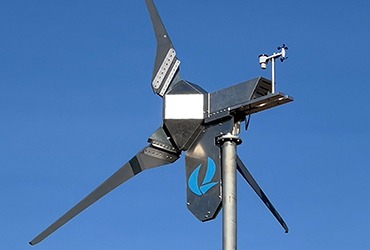
- LuvSide's portfolio includes vertical Helix turbines from 0.5 to 3 kW and the horizontal LS HuraKan 8.0 (~8 kW at 11 m/s, ~12,000 kWh/year), designed for modular use in hybrid microgrids.
Storage and backup
- Batteries enable you to shift surplus solar and wind into evening and night hours, and to reduce diesel runtime dramatically; research on hybrid mini-grids indicates diesel savings up to around 70% when PV and storage are properly dimensioned. (pv-magazine.com)
- Backup gensets are then resized for rare peaks or extended low-resource periods instead of daily baseload.
Controls, balance of plant and engineering
- Hybrid controllers, monitoring systems, cabling, foundations and permitting typically account for 15-30% of project budgets but are crucial for reliability and lifetime ROI.
- As a German wind turbine supplier, LuvSide covers engineering, installation and ongoing wind turbine service and maintenance, simplifying lifecycle budgeting for the wind portion of your system.
Use sector-specific ROI benchmarks
While every site is unique, published benchmarks provide useful guardrails:
- Agriculture & agri-PV - Solar and hybrid systems in farming contexts often achieve 4-8-year payback, especially where they offset energy-intensive pumping, drying or cooling powered by expensive grid or diesel. (fraservalleysolar.com)
- Resorts & remote tourism - Off-grid solar generator and hybrid systems that displace diesel in island or coastal resorts frequently fall in the 3-9-year payback band, with the added benefit of lower noise and stronger sustainability branding. (sunpal-energy.com)
- Mining & construction - Case studies of hybrid mini-grids show cost savings up to 32% and emissions cuts above 80% compared to diesel-only, with sub-7-year paybacks even in challenging humanitarian and remote settings. (arxiv.org)
In budgeting discussions, these ranges help boards and investors align on what "good" looks like before you go to tender.
Insight 3: De-Risk with Phased Deployment
Design a phased roadmap instead of a one-shot megaproject
For most operators, especially in agriculture, tourism and mining, a phased approach to off-grid readiness is both financially and operationally safer:
Phase 1 - Efficiency + solar base layer
Start with energy efficiency and a right-sized PV array plus basic monitoring. This typically captures a solid share of low-hanging fuel savings while building internal experience with decentralised energy assets.Phase 2 - Add off-grid wind for seasonal balance
Once the PV baseline is stable, add small wind turbines where the wind resource justifies it:- Vertical wind turbines from LuvSide provide compact, low-noise generation that is well-suited near buildings, farm infrastructure or coastal resorts.
- Horizontal turbines such as the LS HuraKan 8.0 excel in particularly wind-rich, exposed sites like highland farms or open-pit mines.
Wind reduces your dependence on oversized battery banks and ensures generation during dark, windy periods typical of many European and coastal climates.
Phase 3 - Optimise storage and right-size backup
With a clearer picture of real load profiles and renewable yield, you can finalise battery sizing and progressively scale back diesel capacity. Experience from hybrid microgrids shows that every level of hybridisation-from modest PV add-ons to fully renewable systems-improves cost and emissions versus diesel-only baselines. (arxiv.org)
Interpretation and implications
Phasing converts a daunting capex decision into a sequence of manageable, ROI-positive steps. Each stage should:
- Have a clear savings hypothesis (e.g., "reduce diesel runtime by 30% in Phase 1").
- Include verification via monitoring.
- Reinvest a portion of the savings into the next phase.
This approach reduces technology risk, keeps stakeholders on board, and allows you to bring in partners like LuvSide for targeted wind energy consulting and incremental wind turbine installation when the business case is proven.
Conclusion and Next Steps: Turning Analysis into Action
Budgeting for off-grid energy security starts with facing the real cost of diesel and downtime, then structuring hybrid investments across generation, storage and controls with realistic payback expectations.
For agriculture, tourism and mining projects in windy regions, combining PV with compact small wind turbines from a German manufacturer like LuvSide can significantly improve seasonal balance, reduce storage needs and raise overall system efficiency, all within typical 4-8-year payback windows.
The next step is to model your specific site: load profile, wind and solar resource, diesel logistics and risk appetite. From there, a phased roadmap-PV first, then off-grid wind, then storage optimisation-can move your project from concept to resilient, decentralised energy reality.
Frequently Asked Questions: Budgeting Hybrid Off-Grid Projects
How do I estimate a realistic payback period for my hybrid system?
Use published ranges as a starting point: many commercial and agri-PV projects recover their investment in 4-8 years, while off-grid hybrid systems that replace a large share of diesel can be faster, especially where fuel logistics are costly. (fraservalleysolar.com) A detailed site-specific model will refine this range.
Where does a small wind turbine add the most value compared to PV-only systems?
Small wind turbines become especially valuable in windy regions with significant night-time or winter loads-typical for European farms, coastal resorts and exposed mining sites. Here, wind complements PV by generating when the sun is weak, allowing smaller battery banks and reducing diesel runtime. LuvSide's vertical and horizontal turbines are designed precisely for these decentralised, off-grid wind applications.
What line items should I never forget when budgeting a hybrid project?
Beyond PV modules, wind turbines and batteries, make sure your budget includes: detailed engineering and resource assessment, hybrid controllers and monitoring, foundations and grid connection where relevant, permitting and regulatory work, and a multi-year wind turbine maintenance and service plan. Providers like LuvSide offer end-to-end support-from planning and installation to ongoing service-which helps keep both CAPEX and OPEX transparent over the system's lifetime.