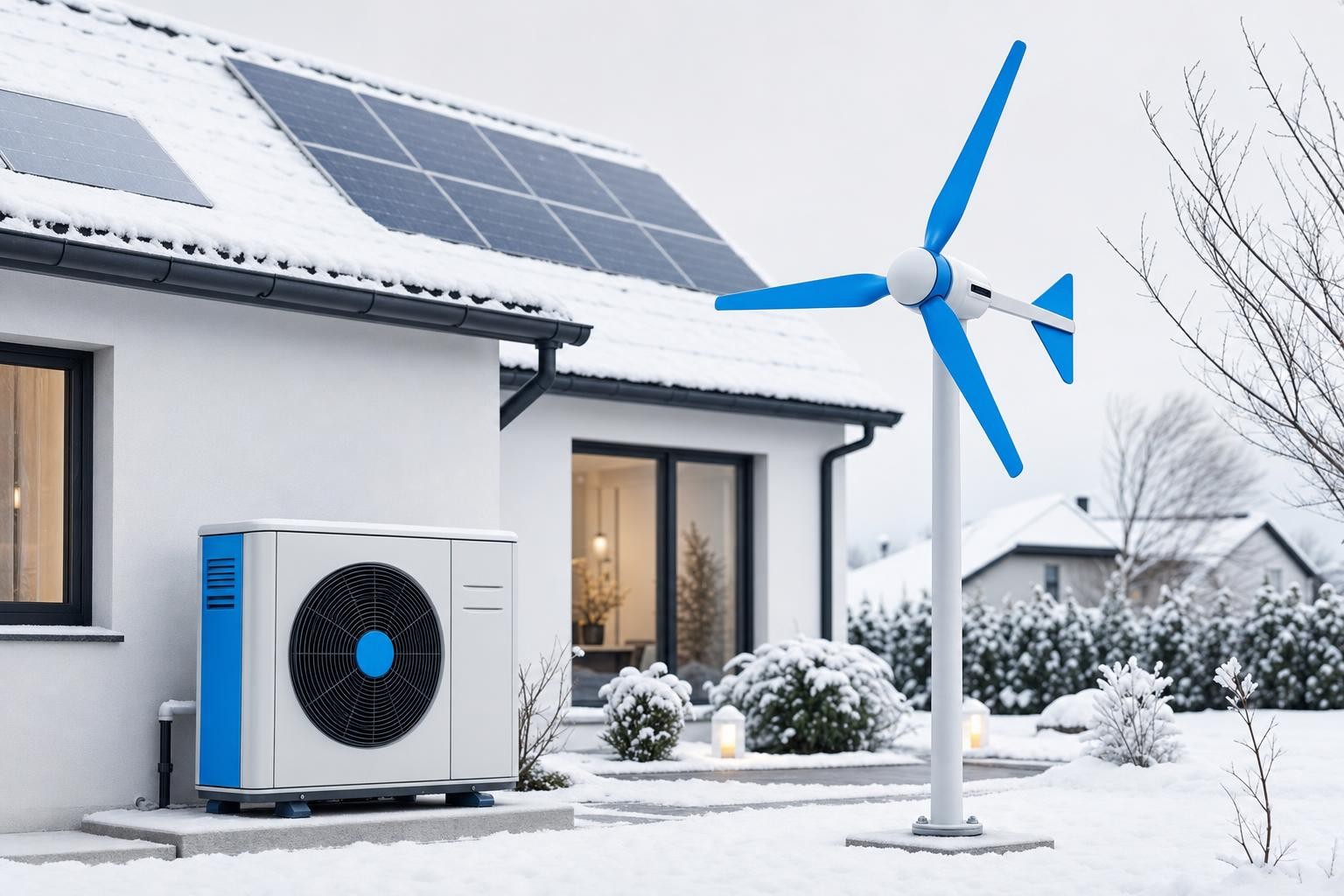
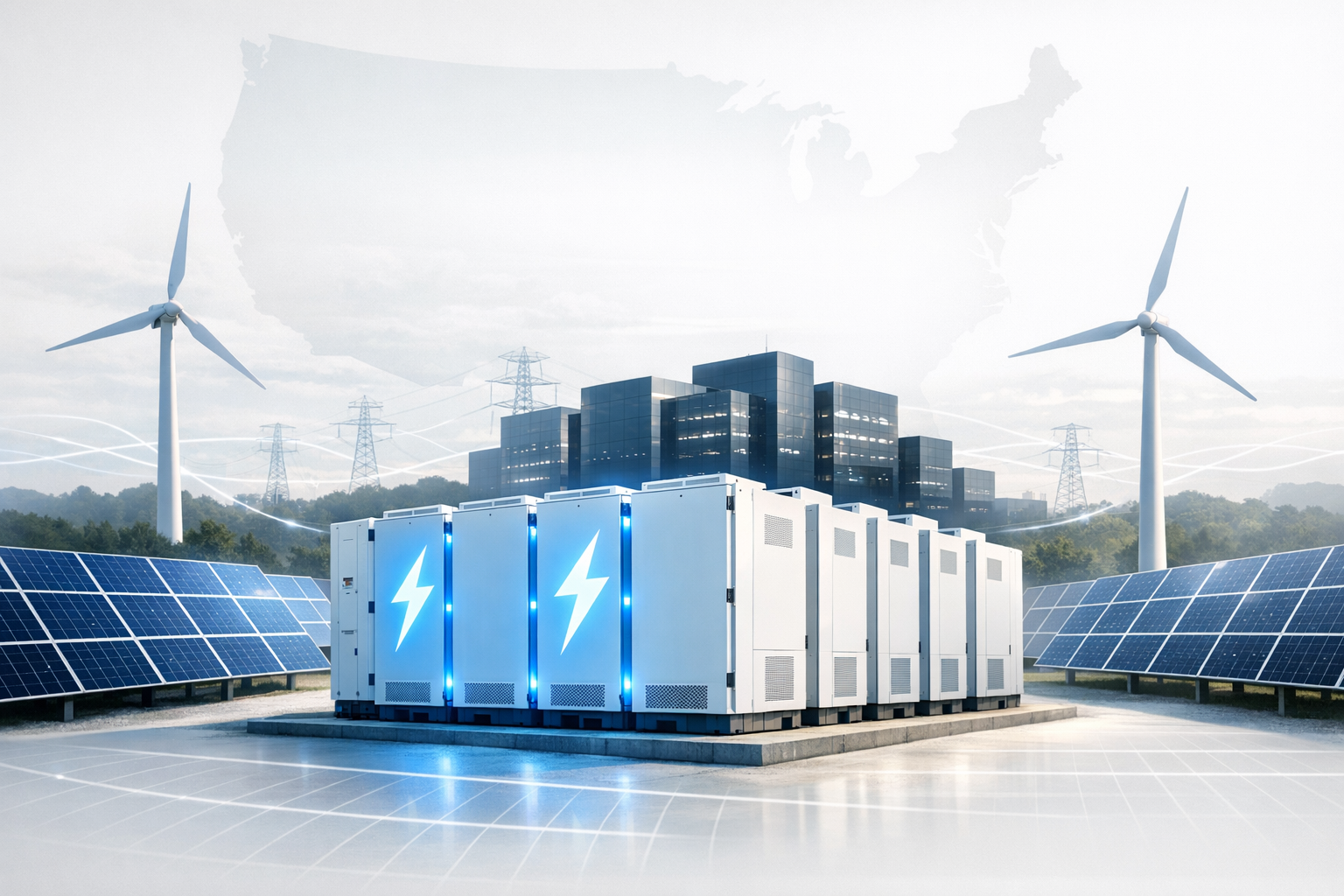
Executive summary. In 2025, the United States installed a record 57 GWh of new battery storage capacity, nearly 30% more than the previous year and dramatically higher than levels from a decade ago.[1] This expansion is driven by rising electricity demand from data centers, evolving market frameworks, tax incentives, and the integration of renewable energy-offering valuable lessons for energy managers planning decentralized, hybrid systems that combine solar, wind, and storage.
For companies, utilities, and data center operators in Europe and beyond, the US boom signals a shift: battery storage is moving from pilot to essential infrastructure. Understanding how grid-scale and behind-the-meter storage interact with distributed renewables-such as small wind turbines and hybrid systems like LuvSide's WindSun-is now a strategic priority.
A record 57 GWh in 2025: what changed in the US storage market?
In 2015, US battery storage on the grid measured just fractions of a gigawatt. Less than a decade later, 2025 alone saw 57 GWh of new installations, according to Solar Energy Industries Association (SEIA) as summarized by Wired.[1] Annual storage additions increased by nearly 30% from 2024, signaling continued rapid growth.
SEIA projects the US could add 70 GWh in 2026, a further ~21% year-on-year increase if current pipelines are fulfilled.[2] For perspective, global grid-scale additions in 2022 were about 11 GW, meaning US annual deployments are now on par with recent global totals.[3]
Key features of the 2025 boom:
- Scale: 57 GWh installed in one year, with ~70 GWh expected in 2026.
- Acceleration: Nearly 30% year-on-year growth.[1]
- Stand-alone focus: Most systems are stand-alone batteries, not directly tied to specific solar plants, reflecting storage's growing role as an independent asset.[1]
- Geographic shift: Texas, with a deregulated market and strong solar growth, is poised to overtake California in battery storage capacity.[1]
Policy headwinds-and why batteries still grew
Growth persisted despite a less supportive environment for wind and solar. While tax credits for renewables were reduced in the US administration's "One Big Beautiful Bill," battery incentives-especially stand-alone-remained largely intact.[1] The Inflation Reduction Act's investment tax credit for stand-alone storage continues to shape project economics, especially in markets like Texas and Arizona, where merchant revenues from price arbitrage and ancillary services are significant.[3]
Lesson for energy managers: even in policy uncertainty, storage that clearly enhances grid flexibility and affordability can gain broad support-because it is technology-agnostic and pairs with gas, nuclear, wind, or solar.
From half a gigawatt to core grid technology
SEIA data highlighted in Wired contrasts today's 57 GWh of annual additions with just half a gigawatt of total storage a decade ago.[1] The International Energy Agency (IEA) estimates global installed battery capacity at 28 GW by end-2022-mostly added within six years-and warns it must grow 35-fold by 2030 to meet Net Zero.[3]
This exponential trend confirms battery storage is now fundamental grid infrastructure, directly impacting distributed and decentralized system planning.
Four structural forces behind the battery storage boom
1. Data centers as a new dominant load
Data centers, especially for AI workloads, are major drivers of new electricity demand. The IEA's Energy and AI report estimates data centers used 415 TWh in 2024, 1.5% of global consumption, with the US accounting for around 45%.[4]
By 2030, global data center demand is set to more than double to ~945 TWh-slightly more than current Japanese electricity usage. In advanced economies, data centers are expected to drive over 20% of demand growth; in the US, they may account for nearly half of demand growth through 2030.[5]
Key consequences:
- Grid connection bottlenecks: Grids struggle to connect new, large loads quickly. IEA warns about 20% of planned data center projects could be delayed by grid constraints.[6]
- Behind-the-meter solutions: To avoid years-long waits for grid upgrades, operators increasingly turn to on-site generation and storage. Benchmark Mineral Intelligence projects data centers will account for 83% of commercial and industrial (C&I) behind-the-meter battery deployments by 2030.[7]
- Local system stress: Nationally modest, data centers can locally dominate demand in certain areas.
This challenge is global. Ofgem reports that in Britain, 140 proposed data centers could require up to 50 GW-more than the country's current peak-if all are built.[8]
For large consumers, storage is critical to:
- Smooth variable computing loads.
- Ensure uptime during grid disturbances.
- Unlock new connections by capping peak demand via peak shaving.
2. Mature lithium-ion technology and falling costs
Lithium-ion batteries-especially lithium iron phosphate (LFP)-have become the standard for stationary storage, leading new grid-scale capacity.[3] Scaling from EV manufacturing and declining system costs make 2-4 hour grid-scale storage competitive with peaker plants in many markets.
Key maturity indicators:
- Capacity growth: Global grid-scale additions grew over 75% in 2022, with 11 GW added.[3]
- Investment: Battery storage investment exceeded USD 20 billion in 2022 and was set to surpass USD 35 billion in 2023, mostly for grid-scale projects.[9]
- Chemistry standardization: LFP batteries dominate stationary storage for cost, cycle life, and safety; other chemistries (NCA, NMC) are mostly used for residential and mobility applications.[9]
This technological maturity reduces risk, with predictable lifetime, degradation, and a broad supplier landscape lowering financing costs.
3. Market design and the US policy mix
US policy remains mixed. The 2022 Inflation Reduction Act introduced a dedicated investment tax credit for stand-alone storage, reducing dependency on co-located solar.[3] At the same time, federal cuts to wind and solar incentives created challenges for new renewable projects.[1]
Yet, state-level design allows batteries to thrive where market signals are strong:
- Texas (ERCOT): An energy-only, deregulated market with high price volatility encourages solar plus storage. By 2025, solar met over 15% of summer demand in Texas-exceeding coal-while batteries captured arbitrage and ancillary services revenues.[1]
- Arizona and California: Longstanding solar history and resource challenges make flexible capacity valuable, driving utility-scale storage procurement.[7]
For global developers, the lesson is clear: storage excels where flexibility is valued and grid operators monetize services like frequency response and congestion relief.
4. Grid utilization and resilience pressures
Most power systems are sized for rare peaks: Wired notes US grids typically use just 50% of capacity daily, with the rest reserved for peak periods.[1]
Batteries:
- Charge during off-peak hours when spare capacity is available.
- Discharge during peaks to avoid overload, cut costs, and defer new grid or peaker plant investments.[3]
- Provide rapid services during disturbances, enhancing resilience.
With increasing weather extremes, cyber risk, and electrification, converting underutilized grid assets into flexible resources makes storage highly attractive both politically and economically.
Centralised vs distributed storage: two roles, one system
Battery storage spans at least three segments: grid-scale front-of-meter systems, C&I behind-the-meter projects, and residential storage. For energy-intensive businesses and data centers, grid-scale and C&I segments are most relevant.
Comparing grid-scale and C&I behind-the-meter storage
C&I projects, typically 250 kW-5 MW per site, are deployed on company premises to lower electricity bills, improve autonomy, and participate in flexibility markets.[10] Grid-scale projects are larger-tens to hundreds of MW-connected at transmission level, operated by utilities or independent producers.
Table 1 - Grid-scale vs C&I behind-the-meter battery storage
| Attribute | Grid-scale front-of-meter batteries | C&I behind-the-meter batteries |
|---|---|---|
| Typical power size | Tens to hundreds of MW (e.g. Hornsdale Power Reserve at 150 MW; Victorian Big Battery at 300 MW).[11] | ~250 kW to 5 MW per site.[10] |
| Connection point | Transmission or high-voltage distribution, operated as system resources.[3] | Connected behind the customer meter at medium or low voltage.[10] |
| Primary users | Utilities, grid operators, merchant storage developers. | Industrial sites, data centers, commercial campuses, logistics hubs.[10] |
| Key use cases | Peak shaving, frequency regulation, reserve capacity, integrating large-scale renewables, deferring grid reinforcement.[3] | Reducing demand charges, maximizing self-consumption of PV, backup power, managing local constraints, occasional flexibility trading.[10] |
| Revenue model | Grid tariffs, capacity and ancillary services markets, energy arbitrage. | Bill savings, resilience, and in some markets, flexibility services.[10] |
| Role in renewables integration | Enables high system-level renewables integration through shifting energy at scale.[3] | Smooths local generation (mainly PV), enables microgrids, reduces needs for large grid connections and backup.[12] |
The US market is mostly led by grid-scale systems, but Axios reports rapid growth in behind-the-meter installations, particularly driven by data centers.[7]
For European and international companies, a two-track strategy is recommended:
- Work with utilities and regulators to ensure accessible, bankable grid-scale storage markets.
- Develop on-site hybrid assets-PV, small wind, and BTM batteries-for direct savings and resilience.
Batteries as enablers of renewable and decentralized energy
The flexibility gap in high-renewable grids
The IEA's Net Zero by 2050 scenario projects grid-scale battery capacity must grow from ~28 GW in 2022 to nearly 970 GW by 2030, with annual additions increasing from 11 GW to 170 GW.[3] This growth enables:
- Hourly balancing of wind and solar PV.
- Fast-response ancillary services stabilizing grid frequency and voltage.
- Short-term backup and black-start after disturbances.
However, batteries do not generate energy. They enable flexibility between variable generation and fluctuating demand. Overreliance on storage alone can inflate project costs, as each hour of autonomy has a direct price.
Hybrid generation + storage: the value of wind alongside solar
A more efficient model combines complementary renewable sources with storage. Solar provides daytime, seasonal production; wind often delivers at night, in winter, or during storms. Pairing both reduces hours that must be bridged entirely by batteries.
LuvSide's portfolio reflects this approach:
- Small vertical- and horizontal-axis wind turbines (0.5-8 kW range, such as LS Double Helix 0.5-3.0 and LS HuraKan 8.0), engineered for reliability and flexible deployment on rooftops, masts, or coastal sites.
- WindSun hybrid systems pair these turbines with photovoltaics in modular packages (~28 kW nominal power at 11 m/s), ideal for off-grid and weak-grid uses.
- The mission: enable autonomous, decentralized energy in windy regions worldwide-from Germany to South Africa and Saudi Arabia-reducing reliance on diesel and unstable grids.
In agricultural projects, combining wind with PV improves seasonal balance and shrinks storage needs and costs, particularly in winter or during Dunkelflaute (dark doldrums) periods. Nighttime and winter wind enables smaller, more efficient battery systems while meeting uptime goals.
Practical hybrid microgrid benefits:
- Lower storage costs: Smaller battery requirements for the same autonomy.
- Better utilization: More frequent but shorter battery cycles, optimizing each installed kWh.
- Improved resilience: Two independent renewables plus storage enhance reliability in variable weather or grid outage.
From rural autonomy to edge data centers
While US deployments focus on large grid-scale batteries, the same toolkit is also valuable for decentralized projects:
- Rural and agricultural: Farms and agri-PV operators in windy areas can install small wind turbines, PV, and C&I-scale batteries to stabilize year-round self-consumption and cut diesel use.
- Telecom towers and edge data centers: For remote, weak-grid sites, hybrid wind-solar-battery systems ensure high uptime and reduced fuel logistics-core to LuvSide's work in telecom and critical infrastructure.
- Coastal and urban: LuvSide turbines, designed for quiet, urban-friendly operation, have been deployed at sites like the V&A Waterfront in Cape Town, delivering visible renewable power and resilience.
The US experience shows storage is now a reliable technology, ready for integration with decentralized generation assets.
Strategic implications for energy managers and data center operators
For European and global leaders-energy managers, sustainability officers, data center developers-the US trajectory highlights these practical lessons:
1. Treat storage as infrastructure
Storage demands the same rigorous planning as substations or grid connections. Consider:
- Long-term modeling of load, renewable generation, and pricing
- Choosing battery duration based on system value, not just backup needs
- Integrating batteries into regulatory frameworks for ancillary or capacity services
2. Stack value streams for better economics
US and European markets show storage is most viable when assets serve multiple roles:
- Peak-load reduction and demand charge savings[10]
- On-site PV and wind self-consumption[12]
- Resilience for critical operations
- Flexibility market participation where permitted[10]
Enabling these stacked values through smart control and contracting is as vital as hardware selection.
3. Combine storage with hybrid renewables
Rather than oversizing batteries for PV-only systems, companies should deploy combinations:
- Rooftop or ground-mounted PV
- Small wind tailored to local conditions
- Right-sized C&I batteries (e.g., 250 kW-5 MW typical for industry sites)[10]
This supports decentralized autonomy and reduces lifetime levelized cost of energy (LCOE) compared to storage-only solutions.
4. Plan early for grid constraints and permitting
IEA and national regulators emphasize increasing grid bottlenecks for new data centers and industrial loads.[5] Early integration of on-site hybrid generation and storage can:
- Lower grid connection requirements
- Speed up project timelines
- Bridge supply needs while waiting for major grid expansions
Frequently Asked Questions
How significant is the US 57 GWh storage boom globally?
The US added 57 GWh in 2025-a quantity matching or exceeding total global grid-scale annual additions from recent years.[1] Global capacity was ~28 GW by 2022, but achieving Net Zero means a 35-fold jump by 2030.[3] The US trajectory sets the benchmark, but worldwide scale-up remains critical.
Why is lithium-ion still dominant, and are alternatives arising?
Lithium-ion, especially LFP, combines lower costs, strong cycle life, and high efficiency, securing its place for most grid-scale and C&I projects.[3] Alternatives include:
- Flow batteries promising 25-30 year lifetimes and scalable energy capacity[9]
- Sodium-ion technologies that could further cut costs when mature[13]
Currently, project finance and supply chains are firmly aligned with lithium-ion.
How does battery storage support decentralized or rural energy?
In rural or weak-grid locations, batteries enable decentralized systems combining local renewables with smaller or no grid connections. Main benefits:
- Stabilization of intermittent PV and wind for farm or village loads
- Reduced diesel usage by covering shortfalls with stored renewable energy
- Backup power during outages, ensuring resilience for irrigation or cold storage
Small wind turbines, providing more power at night and in winter, allow for smaller batteries while maintaining autonomy.
Can small wind turbines significantly reduce battery needs?
Yes, especially in windy areas. Internal design guidance confirms wind plus PV systems achieve better seasonal balance and can cut required storage versus PV-only setups. Small turbines in the 0.5-8 kW range, like LuvSide's Helix and HuraKan, are modular and distributed to smooth on-site generation-and reduce hours batteries alone must supply.
What should companies prioritize for hybrid wind-solar-battery projects?
Energy managers should emphasize:
- Load profile and critical needs: Define essential 24/7 loads
- Resource assessment: Measure local solar and wind to optimize the mix
- Storage sizing and application: Determine if batteries are for peak-shaving, backup, or arbitrage, and size accordingly[10]
- Regulatory/market context: Understand grid codes and monetization opportunities[3]
- Lifecycle economics: Analyze ownership costs over 15-20 years, including O&M and battery replacement
By treating storage as a strategic cornerstone for decentralized, resilient, and sustainable systems, organizations can maximize the benefits of the battery and hybrid renewables era-drawing on the US boom but adapting to their local context.