
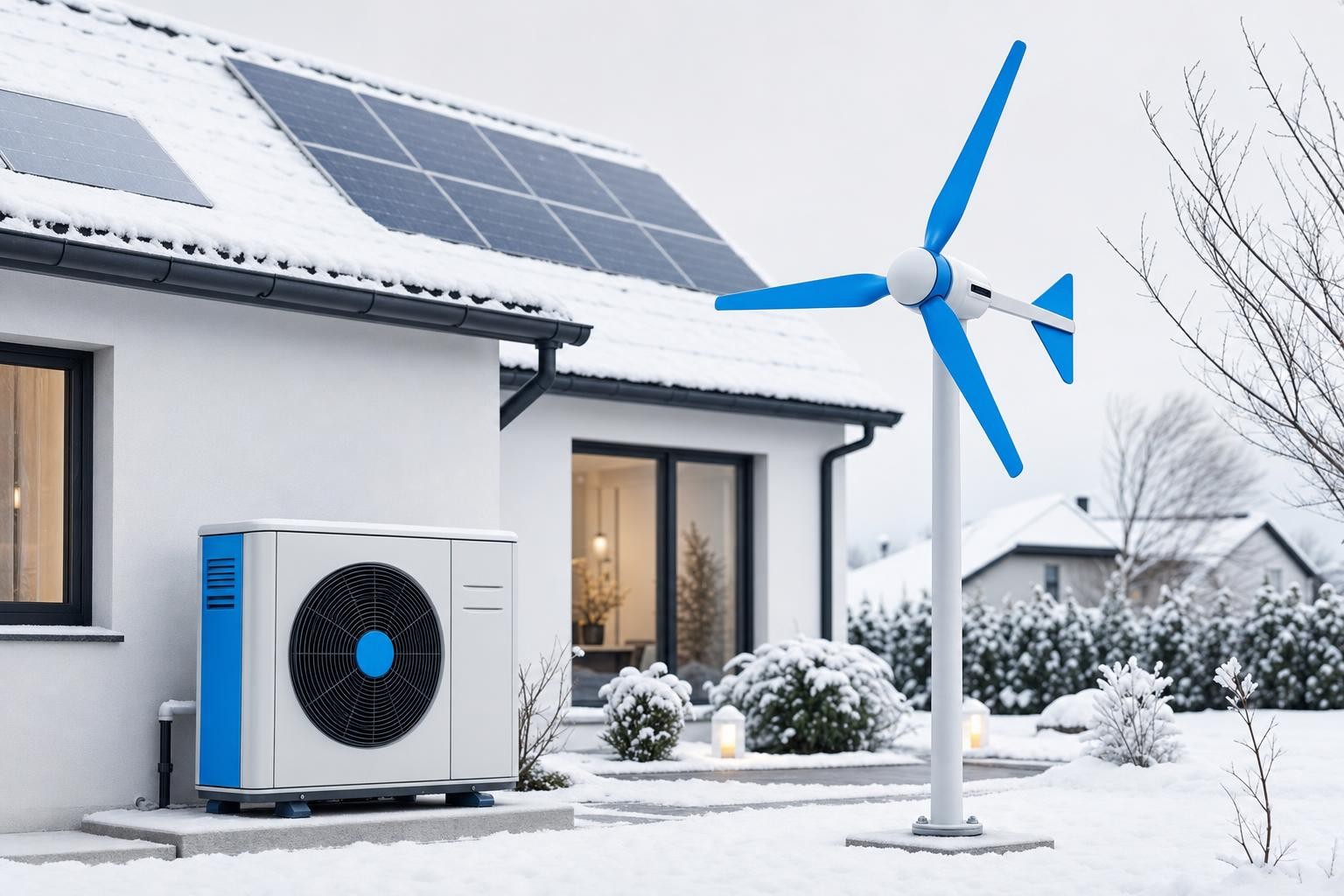
Your heat pump is running flat out. It's January, outside temperatures are hovering near zero, and your rooftop solar panels are producing a fraction of what they managed in July. The electricity meter is spinning in the wrong direction - and it will keep doing so for the next three months.
This is the central tension for every German homeowner who has paired a heat pump with rooftop PV: the two technologies are seasonal opposites. Solar peaks in summer, when the heat pump barely works. The heat pump peaks in winter, when solar output collapses. The mismatch is not a design flaw - it's physics. But there is a technology that follows the exact opposite seasonal curve to solar: wind.
How Much Electricity Does a Heat Pump Actually Use in Winter?
Before talking about solutions, it helps to know the scale of the problem.
A German single-family home heat pump consumes an average of around 4,993 kWh per year for space heating, based on measured data from 27 households. That annual figure, however, is heavily skewed toward the cold months. The load profile tells the real story: in summer, heat pump power draw is low and nearly constant at around 180 W, rising to 500-800 W in spring and autumn, and peaking in winter at roughly 1,000 W or more on cold days.
For a well-insulated new build, annual heat pump electricity demand can be as low as 1,300 kWh. For an older, poorly retrofitted home, it can exceed 13,000 kWh - a factor-of-ten spread depending on building efficiency class. A realistic mid-range figure for a moderately insulated detached house is 4,000-7,000 kWh/year, with roughly 60-70% of that consumed between October and March.
That means a heat pump in a typical German home draws somewhere between 2,500 and 5,000 kWh during the six winter months - the exact period when your solar panels are least productive.
The Solar Winter Problem: Numbers Don't Lie
Germany's solar resource is genuinely good on an annual basis. A 10 kWp PV system in Hannover generates an average of 300-400 kWh in January, compared to over 1,200 kWh in July - meaning winter output is just 20-30% of summer output.
Zoom out to the full year and the imbalance is stark: about 75% of annual solar irradiance in Germany falls in the summer half-year (April to September), while the winter half-year (October to March) contributes only about 25%.
A typical 4-person household consumes around 400-500 kWh in December. Even a 10 kWp system produces only around 150 kWh in Hamburg in December. Add a heat pump to that household and the winter electricity deficit grows dramatically. A battery helps smooth daily fluctuations, but no home battery can store summer solar surplus for use in January - the seasonal gap is simply too large.
The chart above makes the mismatch visual. The two curves barely overlap. PV is abundant precisely when the heat pump is idle; the heat pump is hungry precisely when PV is scarce.
Wind: The Seasonal Mirror Image of Solar
Here is where the physics works in your favour. The reason German winters are cold is the same reason they are windy: in winter, the temperature difference between the tropics and the polar regions is greater, the atmospheric "power plant" works harder, and consequently there are stronger winds.
This is not anecdotal. Research confirms it clearly: wind power in Germany is higher in winter than in summer, while PV power produces a larger amount during summer than in winter - creating a near-perfect seasonal complementarity between the two sources. In fact, in Germany there is a distinct annual cycle with an equal share of generated energy during summer and a 70/30% wind/solar share in winter.
Equally important: low-wind-power events in Germany are generally most frequent in summer (June-August) and least frequent in winter (December-February). The seasons when your solar panels are weakest are the seasons when wind is most reliable.
This is the core argument for adding a small wind turbine to a heat-pump household: not to replace solar, but to fill the seasonal gap that solar structurally cannot fill.
Is Your Site Suitable? Honest Criteria for Small Wind
This is where many guides go wrong by overselling. Small wind is not for every backyard. The single most important factor is average annual wind speed at hub height - and it needs to be sufficient before any other consideration matters.
Small wind turbines typically require an average annual wind speed of at least 4 m/s to function efficiently, with many practical guides using 4.5 m/s as a realistic minimum threshold for meaningful output. Below that, a turbine will spin but produce little economically useful electricity.
Wind power scales with the cube of wind speed. That means a site with 6 m/s average wind produces roughly 3.4× more energy than a site with 4 m/s - not 1.5× more. Getting the site assessment right is everything.
Where small wind works well in Germany:
- Northern coastal regions (Schleswig-Holstein, Lower Saxony coast, Mecklenburg-Vorpommern): consistently the strongest wind resource in Germany. The great majority of wind turbines in Germany have been constructed in the northern part, where favorable wind conditions aided the industry's early development.
- Exposed rural hilltops in central and southern Germany, particularly on ridge lines with clear fetch in the prevailing westerly direction
- Open agricultural land with no significant obstructions within 300-500 m
Where small wind typically does not work:
- Dense suburban or urban settings with buildings, trees, and turbulent airflow
- Sheltered valleys or sites surrounded by forest
- Flat inland areas in central Germany with average wind speeds below 4 m/s at 10 m height
Before investing in any turbine, measure wind speed at your site for at least 3–6 months using a calibrated anemometer at the intended hub height. A wind atlas (e.g. the German Wind Atlas / Windatlas Deutschland) gives a first orientation, but on-site measurement is the only reliable basis for a yield calculation.
Mast height matters more than most buyers expect. Wind speed increases with height, and turbulence - which destroys both yield and turbine longevity - decreases with height above obstructions. A common rule of thumb: the turbine hub should be at least 9 m above any obstacle within 90 m. For most residential sites, this means a mast of 10-18 m.
Permitting Basics in Germany
Permitting for small wind in Germany is governed at the state (Bundesland) level, which means rules vary. The good news: smaller turbines are often straightforward.
According to the Bundesverband Kleinwindanlagen, small wind turbines up to 10 metres tall and with rotor diameters shorter than 7 metres are exempted from construction regulations in most German states - except Berlin, Bremen, Hamburg, Lower Saxony, Rheinland-Pfalz, and Schleswig-Holstein. In those states, a building permit (Baugenehmigung) is required even for small systems.
For turbines above 10 m, a building permit is generally required across all states. In Bavaria, a small wind turbine up to 15 m total height is procedure-free when the mast is routed through the roof, with the roof ridge counted as the zero point. Baden-Württemberg requires a building permit for turbines exceeding 15 m or output above 1 kW.
The practical takeaway: for a compact vertical-axis turbine like LuvSide's Helix series on a modest mast, permitting in most rural states is manageable. In the six states listed above, budget time for a formal application. Always check with your local Baurechtsamt before ordering hardware.
What Can a Small Wind Turbine Realistically Produce?
Honest numbers, not marketing figures. Output depends almost entirely on your site's wind resource:
| Avg. Wind Speed at Hub | Annual Output (3–5 kW turbine) | Verdict |
|---|---|---|
| < 4.0 m/s | < 1,500 kWh | Not viable — symbolic output only |
| 4.0–4.5 m/s | 1,500–3,000 kWh | Marginal — only with excellent siting |
| 4.5–5.5 m/s | 3,000–5,500 kWh | Viable — meaningful winter contribution |
| 5.5–7.0 m/s | 5,500–9,000 kWh | Good — covers significant heat pump demand |
| > 7.0 m/s | > 9,000 kWh | Excellent — coastal/exposed hilltop sites |
The key point: a well-sited 3-5 kW turbine at a location with 5-6 m/s average wind can produce 4,000-7,000 kWh/year - and because wind is winter-weighted, a disproportionate share of that output arrives precisely when the heat pump needs it most.
Costs and Payback: A Realistic Frame
Small wind is not cheap per installed kilowatt. A 9 kW VAWT system starts from around €12,000 before mast and installation, with total project costs varying by site conditions, mast height, and whether grid feed-in connection is required. For smaller 3-5 kW systems, all-in installed costs in Germany typically fall in the €15,000-€35,000 range depending on mast height, foundation work, and grid connection.
For well-sited systems, payback periods typically range from 6 to 12 years. The wide range reflects the cubic sensitivity to wind speed: a site with 6 m/s average wind pays back in 6-8 years; a marginal 4.5 m/s site may take 12+ years or never reach payback.
What moves the economics:
- Self-consumption rate: electricity consumed directly (avoiding grid purchase at ~30-35 ct/kWh) is worth far more than feed-in tariff income
- Heat pump synergy: wind output in winter goes directly into the heat pump, maximising self-consumption value
- KfW financing: KfW loans can reduce the effective capital cost significantly for eligible installations
The honest bottom line: small wind makes financial sense on a good wind site. On a poor wind site, it does not - regardless of how much you want it to.
The Year-Round System: PV + Wind + Battery + Heat Pump
When all four components work together, the seasonal gaps largely disappear:
The result is a system where self-sufficiency is genuinely high year-round - not just in the summer months when solar alone looks impressive. The battery does not need to be oversized to bridge seasonal gaps; it only needs to cover daily and multi-day fluctuations. The wind turbine handles the seasonal shift.
LuvSide's WindSun hybrid system is designed exactly for this architecture: combining the Helix vertical-axis turbine series with photovoltaic generation into a single integrated system, optimised for year-round autonomous energy supply.
Is a Small Wind Turbine Right for Your Home? Find Out Now
Not sure whether your site has the wind resource to make this work? Use the interactive tool below to get a quick first orientation - then talk to an expert for a proper site assessment.
The Honest Summary
Small wind is a powerful complement to rooftop solar for heat pump households - but only on the right site. Here is what the numbers actually say:
- A German heat pump draws 2,500-5,000 kWh in winter - the exact period when solar produces least
- Solar PV in Germany generates 75% of its annual output in the summer half-year, leaving winter largely uncovered
- Wind in Germany is structurally stronger in winter, with low-wind events most frequent in summer - the opposite of solar
- A well-sited 3-5 kW turbine at 5-6 m/s average wind can produce 4,000-7,000 kWh/year, winter-weighted
- Permitting is manageable for compact turbines in most German states
- Payback on a good wind site: 6-12 years; on a poor wind site: not viable
The combination of rooftop PV + small wind + battery + heat pump is the closest thing to a year-round self-sufficient energy system available to German homeowners today. But it starts with an honest site assessment.
Not sure if your property has the wind resource to make this work? LuvSide's experts have been assessing small wind sites since 2014. Get an honest, numbers-based evaluation — no obligation.
Request a Free Site Assessment